

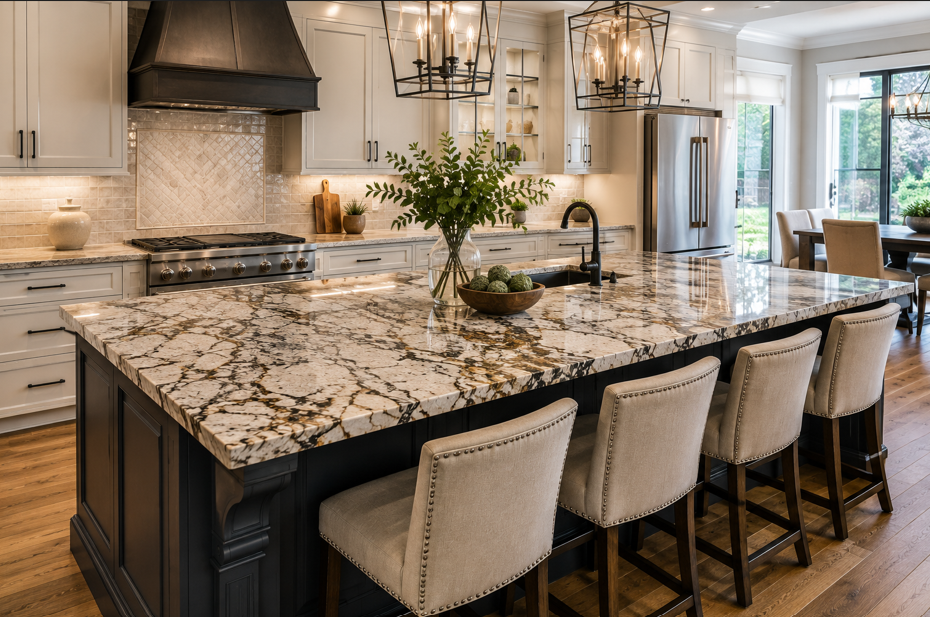
A kitchen island can do far more than provide extra counter space. In many homes, it becomes the centre of everyday life — a place for preparing meals, sharing breakfast, helping with homework, entertaining friends, and gathering with family. When the island is designed as a focal point, the countertop has an especially important role in defining the room.
For Baker homeowners who want a kitchen with lasting character, natural granite offers a distinctive combination of beauty, durability, and individuality. Every granite slab has its own colour movement, mineral deposits, veining, and pattern, allowing a kitchen island to become a genuine statement piece rather than another repeated surface.
At Wholesale Flooring & Granite, customers can see and hand-select natural granite slabs directly from warehouse inventory. Instead of making such an important design choice from a small sample, you can view the full slab and choose the exact stone that will become part of your kitchen.
From dramatic waterfall-style designs to timeless islands created for busy family kitchens, this guide explores how Baker homeowners can design a custom granite island that looks exceptional and performs for years.
Why Granite Works So Well for Kitchen Islands
Kitchen islands are naturally suited to granite because they provide a large, uninterrupted area where the character of natural stone can be fully appreciated.
On a short section of countertop, some of a slab's most interesting movement may be lost through cuts for corners, walls, appliances, or sinks. An island often provides a broader canvas.
This can make features such as sweeping veins, contrasting mineral deposits, subtle colour transitions, and crystalline details more noticeable.
Every Granite Island Can Be Different
Natural granite is formed through geological processes rather than manufactured to repeat a printed pattern.
Two slabs from the same general granite variety can still contain noticeable differences. One may have more movement, another may be quieter, and another might include a mineral feature that becomes the focal point of the entire installation.
That individuality is one reason granite works particularly well for homeowners who want their kitchen to feel custom.
Your neighbour can choose the same cabinet style or appliance finish, but the natural characteristics of your particular slab remain unique.
Granite Has the Visual Weight an Island Needs
A kitchen island often serves as the room's visual anchor.
Because it sits away from the walls and cabinetry, the eye naturally notices its proportions, colour, lighting, seating, and countertop.
Granite provides enough visual substance to make that feature feel intentional. A restrained granite can create subtle sophistication, while a highly patterned stone can transform the island into the main design statement.
It Also Handles Everyday Family Life
A beautiful island still needs to work.
Family kitchens can expose countertops to meal preparation, serving dishes, drinks, school projects, grocery bags, entertaining, and daily cleaning.
Properly selected, fabricated, sealed, and maintained granite offers the durability needed for an active kitchen while maintaining a premium natural-stone appearance.
That balance between design and practicality makes it especially attractive for a feature that receives as much use as an island.
Designing the Island Around the Granite Slab
Many homeowners choose cabinets and then look for a countertop that fits the finished design.
With a statement granite island, it can be equally effective to work in the opposite direction.
If you discover a slab with exceptional colouring or movement, that stone can help guide the rest of the island design.
Start With the Full Slab
A small granite sample can tell you the general background colour, but it cannot show how the entire pattern moves.
This matters considerably on a kitchen island.
Imagine a granite slab with a broad vein moving diagonally from one end to the other. On a sample, you may see a few centimetres of colour. Across an island, that same feature could create a dramatic natural composition.
Viewing the entire slab allows you to consider:
where the strongest movement appears;
how the pattern could run across the island;
which areas are calmer or more dramatic;
where sink or hob cut-outs may fall;
how the stone coordinates with cabinetry and flooring; and
which section you would most like to feature.
This is where the warehouse showroom model offers an important advantage.
Customers can select their actual stone rather than relying entirely on a sample that represents only a small section of the material.
Consider the Direction of the Pattern
Granite with noticeable movement can often be oriented to complement the shape of the island.
A long island may look especially impressive when the stone's movement follows its length. In other designs, diagonal veining can add energy and make the island feel more dynamic.
The right orientation depends on the slab and the room.
Working through this before fabrication gives you more control over the final appearance.
Granite Colours That Make Beautiful Statement Islands
A statement island does not automatically require the boldest granite available.
Sometimes contrast makes the statement. Other times texture, movement, or subtle variation creates the interest.
When exploring granite countertops, consider how the stone will interact with the cabinets, flooring, walls, lighting, and surrounding countertops.
Light Granite for Bright, Open Kitchens
White, cream, beige, and pale grey granite can make a kitchen feel open and welcoming.
These colours work particularly well in spaces with darker island cabinetry because the contrast helps define the island without making the room feel heavy.
Light granite may include black, grey, brown, gold, or mineral accents, giving homeowners plenty of opportunities to coordinate other finishes.
For Baker homes with open-plan kitchens, a lighter stone can also help the kitchen transition naturally into adjacent living or dining areas.
Dark Granite for Strong Contrast
Black, charcoal, and deep brown granite can create a dramatic look, especially against white or light-coloured cabinetry.
A dark island top can act as an anchor in a large kitchen and work beautifully with metallic fixtures, warm wood finishes, and lighter flooring.
Consider the room's natural and artificial lighting when using deeper colours. A kitchen with generous windows and layered lighting can support a darker focal point particularly well.
Warm Granite for Inviting Louisiana Interiors
Granite featuring cream, tan, caramel, gold, brown, or warm mineral tones can create a welcoming atmosphere.
These stones coordinate naturally with wood cabinetry and traditional interiors, but they can also work in updated transitional kitchens when paired with simple cabinet profiles and contemporary hardware.
Warm granite can be particularly effective for homeowners who want a premium kitchen without creating a space that feels overly formal.
Dramatic Movement for a True Focal Point
Some granite slabs contain sweeping veins and strong colour variation.
On a large island, these patterns can feel almost like natural artwork.
When choosing dramatic stone, consider keeping some surrounding finishes quieter. Simple cabinetry, understated flooring, and a restrained backsplash allow the granite to remain the star of the design.
Should the Island Match the Perimeter Countertops?
It does not have to.
Using a different material, colour, or granite variety on the island can help define it as a feature.
Matching Granite Creates Continuity
Using the same granite across the island and perimeter countertops creates a cohesive, unified appearance.
This approach is particularly effective when the selected granite already contains enough movement to make the space interesting.
Matching surfaces can also help smaller kitchens feel visually connected.
Contrasting Granite Creates a Focal Point
A contrasting island gives homeowners greater freedom to create a statement.
For example, a light perimeter countertop could be paired with a darker granite island, or restrained perimeter surfaces could surround an island featuring more dramatic natural movement.
The contrast does not need to be extreme.
A granite island with warmer movement may complement quieter countertops that share one of the same background tones.
Coordinate Rather Than Match Everything
Successful kitchen design rarely requires every surface to be identical.
Instead, look for relationships between the colours.
A dark mineral in the granite might coordinate with cabinet hardware. Warm veining could connect with wood flooring. Grey movement may relate to surrounding countertops or backsplash tile.
These repeated colour notes help the kitchen feel intentional.
Choosing the Right Island Size and Overhang
A statement island needs to look proportional to the room while remaining comfortable to use.
Larger is not automatically better.
The island needs appropriate clearance from surrounding cabinets and appliances so people can move through the kitchen and open doors comfortably.
Its dimensions also depend on how the space will function.
Will the island primarily provide food preparation space? Will it include seating? A sink? Storage? Appliances? A combination of several functions?
Answering those questions before finalising the stone helps determine the appropriate size and configuration.
Seating Overhangs
Breakfast seating is one of the most popular ways to make an island more useful for families.
An appropriate countertop overhang can create room for stools while preserving storage underneath.
The required support depends on the depth of the overhang, granite thickness, island construction, and design. Longer unsupported spans may require brackets or another support solution recommended by the fabricator.
Good support planning allows the stone to remain visually clean without compromising performance.
Large Islands and Seams
Very large islands may require more than one piece of stone depending on slab dimensions and the final layout.
If avoiding a seam is important, selecting the slab and determining available dimensions early in the design process is valuable.
Seeing the full slab before fabrication also helps determine whether it can accommodate the island dimensions while capturing the section of stone you want to feature.
Edge Profiles Can Change the Character of the Island
An edge detail may seem small compared with the colour of the granite, but it has a noticeable effect on the finished island.
Eased Edges
A simple eased edge creates a clean, versatile appearance.
It works well in modern, transitional, and understated kitchens and allows dramatic granite movement to remain the main focus.
Rounded Profiles
Softer edge profiles can create a comfortable, approachable appearance and may suit family-oriented kitchens where people regularly sit or gather around the island.
Decorative Edges
More detailed profiles can add traditional character, especially when paired with decorative cabinetry and substantial stone.
They are most effective when the scale of the edge suits the proportions of the island.
A highly elaborate edge on a small island can feel visually heavy, while a larger premium kitchen may support more detail comfortably.
The goal is to let the edge contribute to the overall design rather than compete with the granite itself.
Polished, Honed, and Textured Granite Finishes
The finish affects how both the colour and texture of granite appear.
Polished Granite
A polished surface has a smooth, reflective appearance that highlights colour and mineral detail.
It remains a familiar choice for kitchen islands because it provides a refined look and can make dramatic stone appear even more vibrant.
Honed Granite
Honed granite has a softer, more matte appearance.
The reduced reflection can make the stone feel understated and architectural. Depending on the particular granite, a honed finish may appear slightly different in colour from the polished version.
Textured Finishes
Leathered and other textured finishes can add tactile character.
These finishes are particularly effective on darker granite and can create a sophisticated natural-stone look without the high reflection of a polished surface.
Maintenance characteristics can vary by stone and finish, so it is worth discussing the intended use of the island when choosing between them.
Granite Islands and Louisiana's Climate
Baker homeowners need countertops that suit South Louisiana living as well as their preferred design.
Louisiana's humid subtropical climate means moisture is a constant consideration in kitchens. Summer humidity, heavy rainfall, cooking, sinks, dishwashers, and everyday spills can all contribute to a moisture-rich environment.
Granite can perform very well in these conditions when it is properly fabricated, installed, sealed, and maintained.
Because natural granite has varying levels of porosity, appropriate sealing helps reduce absorption and staining. The specific stone, type of sealer, and amount of use influence how frequently resealing may be appropriate.
Rather than relying on a universal schedule, homeowners can monitor the countertop and follow care recommendations for their particular stone.
Granite also offers strong heat resistance, which is useful in busy kitchens. Even so, trivets and protective pads remain a sensible habit around very hot cookware because they also protect sealers and surrounding finishes.
Routine care is generally straightforward. Promptly clean spills, use products appropriate for natural stone, and avoid cleaners that could damage the finish or sealer.
With sensible maintenance, a granite kitchen island can continue looking impressive through years of family meals, entertaining, celebrations, and everyday use.
Make the Island Work Harder With Smart Features
A statement island can still be highly practical.
Consider integrating features that make the space work better for your household.
Deep Drawers
Large drawers can provide convenient storage for cookware, serving dishes, and small appliances.
Waste and Recycling Storage
Built-in waste storage can keep bins out of sight while positioning them close to food preparation areas.
Electrical Access
Strategically placed outlets make the island more useful for small appliances, laptops, phones, and other everyday needs.
Island Sink
A sink can turn the island into a major food-preparation zone, although its position needs careful planning so the cut-out does not remove one of the most attractive sections of the selected granite.
Statement Lighting
Pendant lighting helps frame the island visually and can emphasise the colour and movement of polished granite.
The scale of the fixtures needs to suit both the island and the ceiling height.
These practical details allow the island to become a true working centre rather than a purely decorative feature.
Why Hand-Selecting Your Granite Slab Matters
A custom island is one of the best opportunities in a kitchen to showcase natural stone, which makes slab selection especially important.
Online photographs can help you discover colour families and inspiration, but natural granite cannot be evaluated completely from a screen.
Lighting affects colour. Scale affects the way patterns appear. Every slab contains its own variation.
By viewing granite at the warehouse showroom, you can walk around the slab, examine the movement from a distance, look closely at mineral details, and compare it directly with other options.
You can also bring cabinet, flooring, paint, or backsplash samples when available.
This turns the selection process into a coordinated design decision rather than a guess based on individual photographs.
Wholesale pricing adds another advantage. Instead of thinking of premium natural stone purely in traditional retail terms, customers can explore quality granite while considering the overall project budget.
Create a Kitchen Island Built to Be Remembered
A well-designed granite island can change the entire character of a Baker kitchen.
It can introduce natural colour and movement, create contrast with surrounding cabinets, provide valuable preparation and seating space, and establish a focal point that gives the room an unmistakably custom feel.
The best results come from looking at the complete picture: the dimensions of the island, the full granite slab, pattern direction, cabinet colour, flooring, edge profile, finish, seating, lighting, storage, and the way your family uses the kitchen every day.
Natural granite makes that design especially personal because no two slabs are exactly alike.
Whether you prefer understated stone with subtle movement or a dramatic slab that immediately draws attention, seeing the material at full scale can make the decision considerably easier.
Ready to find a granite slab for your Baker kitchen island? Visit our showroom or contact us for a free estimate and explore hand-selected natural granite options with guidance from the Wholesale Flooring & Granite team.


