

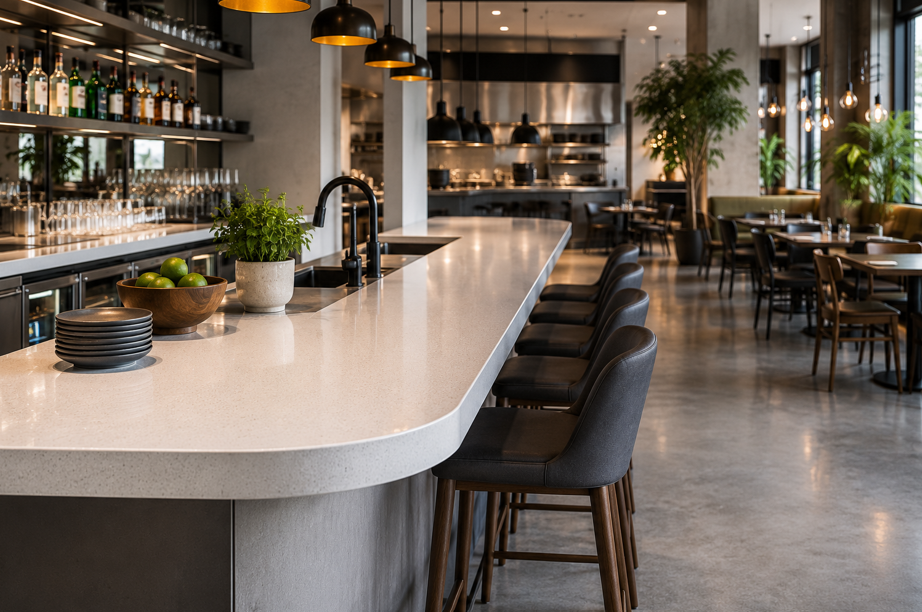
Commercial countertops work harder than most residential surfaces. In a restaurant, café, hospitality space, office, retail counter, or other customer-facing business, a worktop may deal with constant cleaning, spills, food preparation, customer traffic, equipment, moisture, and daily wear. Appearance still matters, but performance and maintenance become equally important.
For businesses in Ascension Parish, solid surface countertops offer a useful balance of durability, clean design, repairability, and low-maintenance performance. The material can be fabricated with smooth transitions and discreet seams, and many colours and patterns are available to coordinate with both front-of-house and back-of-house spaces.
At Wholesale Flooring & Granite, commercial clients can compare countertop materials in person and get knowledgeable guidance on selecting surfaces for the way a business actually operates. That matters because the right countertop for a busy service counter may be different from the best choice for a reception desk, restroom vanity, break room, or restaurant prep area.
This guide explains where solid surface performs well, what businesses need to consider before selecting it, and how to plan a commercial countertop project with long-term value in mind.
Why Solid Surface Works Well in Commercial Interiors
Solid surface is an engineered countertop material made to create a consistent, durable work surface. Unlike natural stone, its appearance is manufactured rather than formed by geological variation. That gives designers and business owners access to a broad range of colours, patterns, and visual styles with relatively predictable results across a larger project.
One of its biggest commercial advantages is the ability to create a smooth, cohesive appearance.
Fabricated joints can often be made visually discreet, helping long counters look continuous. Backsplashes and some sink configurations can also be integrated into the design, depending on the product and fabrication plan. Fewer pronounced joints and transitions can make routine cleaning more straightforward in spaces where staff are wiping surfaces throughout the day.
Solid surface is also nonporous as a material, so it does not require sealing in the same way many natural stones do. For commercial operators trying to keep maintenance routines manageable, removing periodic stone sealing from the maintenance schedule can be valuable.
Another advantage is renewability. Minor scratches, scuffs, and certain forms of surface wear can often be sanded or refinished by a qualified professional. That can extend the useful appearance of a countertop in a busy environment where replacement would be disruptive.
For business owners, this combination of consistent design, straightforward care, and repair potential can make solid surface a practical long-term option rather than simply an aesthetic selection.
Restaurants and Food-Service Spaces
Restaurants place unusual demands on countertop materials because different areas serve very different purposes.
A customer-facing counter may need to look polished throughout the day. A beverage station may encounter repeated spills. A host stand needs to withstand contact from keys, phones, menus, bags, and cleaning products. Restroom vanities need to cope with moisture and frequent cleaning.
Solid surface can fit many of these applications well.
Service and Transaction Counters
Front counters influence the first impression customers form when they enter a restaurant or café. Solid surface can create a clean, modern appearance without requiring an elaborate maintenance routine.
Neutral whites, warm creams, soft greys, darker tones, and stone-inspired patterns can support many interior concepts. A restaurant aiming for a contemporary look may favour a restrained solid colour, while a hospitality-oriented space may prefer a pattern with subtle movement.
Because the material can be fabricated into long, visually continuous sections, it also works well for order counters, cashier stations, pick-up areas, and coffee bars.
Restroom Vanities
Commercial restrooms benefit from surfaces that tolerate regular moisture and cleaning. Solid surface is particularly useful here because of its nonporous nature and the potential for integrated backsplash or basin details.
Reducing open joints around wet areas can simplify everyday cleaning and create a neater appearance.
Break Rooms and Staff Areas
Employee kitchens and break rooms rarely need the same visual emphasis as a customer-facing bar, but they still need reliable surfaces. Solid surface can provide a cost-effective way to keep the design consistent across a commercial project while giving staff an easy-to-maintain worktop.
For areas involving direct food preparation, equipment, or specialised sanitation requirements, the countertop specification needs to be evaluated alongside the applicable local health, building, and operational requirements. Material selection is only one part of creating an appropriate commercial workspace.
Commercial Spaces Beyond Restaurants
Solid surface is not limited to food service. Its design flexibility makes it useful in a wide range of commercial interiors.
Reception Desks
Reception areas in medical offices, professional practices, salons, hotels, and service businesses often need a surface that feels polished but can still deal with constant contact.
A solid surface reception counter can be fabricated to coordinate with cabinetry, wall finishes, flooring, and brand colours. The material can also be shaped into curves or other custom details when the selected product and fabrication method allow it.
Retail Counters and Displays
Retail counters experience repeated contact from products, bags, payment devices, displays, and customers. Solid surface gives store owners a consistent material that can be used across transaction counters, display areas, and consultation stations.
Lighter colours can help a small retail interior feel open and bright, while darker or more heavily patterned options can add contrast in larger spaces.
Healthcare and Professional Environments
Waiting areas, consultation counters, restroom vanities, and administrative workspaces can benefit from the material's smooth, nonporous surface and clean visual appearance.
The exact product specification still needs to match the requirements of the intended environment. A general office counter and a specialised clinical work surface do not automatically have the same performance or compliance needs.
Hospitality Spaces
Hotels, event venues, entertainment spaces, and other hospitality businesses may use solid surface at check-in counters, bars, vanities, refreshment areas, and service stations.
For operators managing multiple areas, the broad colour range can help create a consistent design language without requiring every surface to look identical.
The Maintenance Advantage for Busy Businesses
Commercial maintenance is not only about keeping a surface attractive. It also affects staffing, downtime, customer impressions, and the useful life of the interior.
A material that requires a highly specialised daily routine can create unnecessary work. Solid surface is popular in commercial settings partly because routine care is generally straightforward.
For everyday use, spills can usually be wiped promptly and surfaces cleaned with products appropriate for the specific manufacturer and finish. Because the material does not rely on a penetrating sealer, owners do not need to plan recurring sealing in the way they may with certain natural stone surfaces.
The repair potential is another important consideration.
A heavily used counter may develop scuffs or fine scratches over time. Depending on the severity and the finish, some wear can be renewed rather than requiring complete countertop replacement. Professional refinishing can be especially useful for businesses that want to refresh a customer-facing surface after years of service.
Colour and finish selection can influence how visible daily wear becomes. Very dark, high-contrast surfaces can show dust, fingerprints, or fine marks more readily than some mid-tone or patterned options. In a high-traffic setting, selecting a pattern that helps disguise routine wear can make the countertop easier to live with.
When browsing solid surface countertops, it is worth considering maintenance at the same time as colour. A surface that looks beautiful in the showroom also needs to suit the cleaning routines, staffing patterns, and traffic level of the business.
Louisiana Humidity, Moisture, and Commercial Countertops
South Louisiana's climate adds another layer to commercial material selection.
Humidity, summer heat, frequent rainfall, and wet conditions can increase the amount of moisture brought into restaurants and businesses. Entrances see wet shoes and umbrellas. Kitchens and beverage stations already generate moisture internally. Restrooms remain humid during busy periods, and air-conditioning systems work hard throughout much of the year.
Countertops do not experience climate in exactly the same way flooring or wood cabinetry does, but moisture resistance still matters in wet and high-use spaces.
Solid surface has an advantage because the material is nonporous and does not need periodic sealing. That can simplify maintenance in environments where water, drinks, cleaning, and humidity are part of normal daily operations.
Good design still matters. We recommend avoiding standing water around joints, fixtures, wall transitions, cabinetry, or other materials that may have different moisture tolerances. Proper fabrication, installation, ventilation, and routine cleaning all contribute to a durable commercial interior.
Businesses also need to consider heat.
Solid surface can perform very well in many commercial applications, but it is not intended to have very hot cookware or heat-producing equipment placed directly against it without suitable protection. Restaurants need to plan heat exposure carefully around kitchen equipment, hot service areas, coffee equipment, and other appliances.
Matching each countertop location to its actual working conditions is far more useful than assuming one material is ideal for every surface in the building.
Design Options for Customer-Facing Spaces
Commercial design has a direct effect on how customers experience a business.
A restaurant counter can reinforce a casual, upscale, traditional, industrial, or contemporary identity. A medical reception area can feel calm and organised. A salon can use the counter as part of a more dramatic visual concept.
Solid surface gives designers flexibility because the material is available in many tones and patterns.
Light Neutrals
White, ivory, beige, and pale grey surfaces can make commercial spaces feel bright and clean. They work particularly well with natural wood cabinetry, dark accents, and colourful wall finishes.
Stone-Inspired Patterns
Businesses that want more visual movement can select solid surface designs inspired by stone. These options can provide depth without the natural variation that comes with selecting individual slabs of granite or other stone.
Dark and Dramatic Colours
Charcoal, deep grey, and darker patterns can create a strong visual anchor, particularly at reception desks, bars, or retail counters.
These colours can be striking, although day-to-day visibility of fingerprints, dust, or surface marks is worth considering when choosing the finish.
Coordinating Several Areas
One business does not need to use the exact same colour everywhere.
A restaurant might choose a distinctive pattern for the front counter and a simpler coordinating colour for restroom vanities and staff areas. A professional office could use one colour family across reception, break room, and restroom spaces while varying tone or pattern.
This creates consistency without making the interior feel repetitive.
Comparing Solid Surface With Other Commercial Countertop Materials
Commercial clients often compare solid surface with granite, quartz, laminate, stainless steel, and other specialised surfaces.
There is no single winner for every application.
Natural granite offers distinctive one-of-a-kind stone character and strong heat resistance, but it requires appropriate sealing and maintenance. Quartz offers a hard engineered surface with many design choices, although heat exposure and the specific manufacturer's care requirements need consideration. Laminate can provide excellent value for lower-demand applications but does not offer the same renewability or discreet fabrication possibilities as solid surface. Stainless steel remains highly practical for many professional food-preparation environments but creates a very different visual character.
Solid surface is particularly attractive when a business prioritises:
a smooth, cohesive appearance;
nonporous material;
discreet fabricated seams;
integrated design possibilities;
straightforward everyday maintenance;
broad colour and pattern choice; and
the potential to repair or refinish some forms of wear.
The best material may also vary within a single project. A restaurant can use one surface in a specialised back-of-house location and solid surface for customer-facing counters, vanities, and service areas.
A mixed-material plan often gives commercial owners the best combination of performance, appearance, and budget control.
Planning a Commercial Solid Surface Project
A successful commercial countertop project begins with understanding how every area will be used.
Before selecting colours, identify the practical requirements of each counter.
Consider:
daily traffic and frequency of use;
exposure to water, drinks, food, chemicals, or cleaning products;
potential contact with hot equipment;
required sink, tap, electrical, or equipment cut-outs;
accessibility and customer-service requirements;
edge and backsplash details;
cabinetry or support conditions;
cleaning routines;
project phasing and business downtime; and
the visual role of the counter within the overall interior.
Measurements and fabrication planning are particularly important in commercial spaces because counters may need to work around equipment, walls, columns, service openings, point-of-sale systems, or existing cabinetry.
Early coordination can also reduce disruption. If a business is renovating while remaining operational, installation timing may be planned around quieter periods or phased areas.
Professional guidance helps connect the design choice with these practical details before material is ordered and fabricated.
Is Solid Surface the Right Choice for Your Ascension Parish Business?
For many restaurants and commercial spaces, solid surface offers a strong combination of appearance, practical care, and design flexibility.
It is especially worth considering for reception counters, customer-service areas, restroom vanities, coffee bars, hospitality spaces, break rooms, and other locations where businesses want a smooth, durable, easy-to-maintain surface.
Its nonporous construction eliminates the need for periodic stone sealing. Visually discreet seams can create a clean appearance across longer counters. A wide variety of colours makes it adaptable to different commercial brands and interiors, while professional refinishing can extend the appearance of some well-used surfaces.
The most effective specification still depends on the individual application. Heat exposure, specialised sanitation requirements, equipment, traffic level, cleaning methods, and local regulations all need to be considered as part of the project.
For businesses in Ascension Parish, that makes seeing material options and discussing actual operating conditions an important part of the selection process.
Explore Commercial Countertop Options in Person
A restaurant or commercial countertop is a working part of the business, not simply a decorative finish. Selecting it carefully can make everyday cleaning easier, support the design of the space, and help the interior continue looking professional under regular use.
Wholesale Flooring & Granite serves residential and commercial clients across the greater Baton Rouge area with flooring, countertops, cabinets, professional expertise, and a warehouse showroom model focused on value and selection.
If you are planning a restaurant, office, retail, hospitality, or other commercial renovation, contact us to visit the showroom or request an estimate. Our team can help you compare solid surface options and choose a countertop solution that fits your space, design goals, daily operations, and project budget.


