

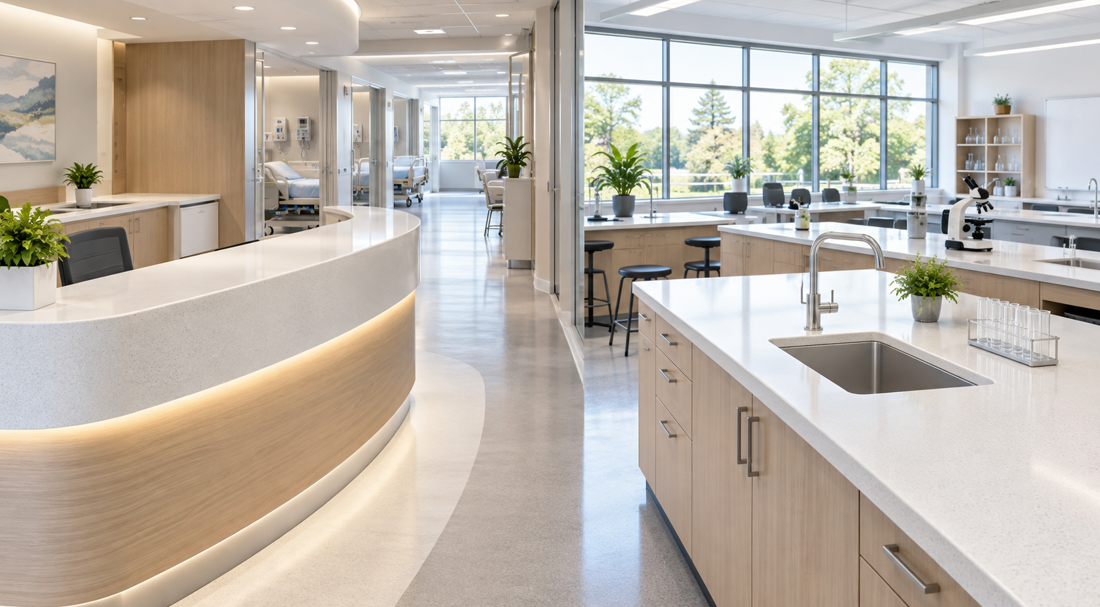
Schools, clinics, medical offices, and other public facilities ask more from a countertop than the average residential kitchen. Surfaces may be used by dozens or even hundreds of people in a day. They need to stand up to frequent cleaning, spills, moisture, equipment, paperwork, food service, and the everyday wear that comes with busy shared spaces.
For facility managers, designers, contractors, and business owners in Ascension Parish, material selection therefore becomes a balance of durability, maintenance, appearance, and long-term value. Solid surface is one option worth serious consideration because it combines a nonporous surface with flexible fabrication and a clean, consistent look.
At Wholesale Flooring & Granite, commercial customers can compare surface options with guidance from a local team that has served the greater Baton Rouge area for more than 18 years. Whether the project involves a school reception desk, clinic work counter, restroom vanity, cafeteria serving area, or administrative space, choosing the right material early can make ongoing maintenance much easier.
Here is how solid surface can fit education and healthcare projects in Ascension Parish — and what to consider before specifying it.
Why Commercial Countertops Need a Different Approach
A countertop in a commercial or institutional setting has a very different job from one in a private home. In a school, surfaces may be exposed to backpacks, art supplies, food, cleaning products, water bottles, technology, and constant movement. In a healthcare environment, counters may also need to tolerate repeated cleaning and disinfecting while supporting staff workflows throughout the day.
That makes appearance only one part of the decision.
Commercial surfaces need to be evaluated for how easily they can be cleaned, how they handle moisture, how visible wear will be, whether minor damage can be repaired, and how well the material can be fabricated around sinks, corners, wall transitions, and specialised work areas.
Solid surface is commonly considered for these environments because it is nonporous and can be fabricated with inconspicuous seams. Depending on the design and installation, backsplashes and sinks can also be integrated in ways that reduce ledges and joints where dirt and moisture might otherwise collect.
That does not mean every solid-surface product is suitable for every school or healthcare application. Product specifications matter. For a clinic, medical facility, laboratory, food-service area, or other regulated space, the exact material needs to be checked against the project's cleaning protocols, code requirements, fire-performance needs, chemical exposure, and other technical criteria.
For many everyday commercial spaces, though, the combination of cleanability and design flexibility makes solid surface a practical material to explore.
It can also help create a warmer, less institutional appearance. Today's solid-surface colours range from simple whites and soft neutrals to stone-inspired patterns and deeper tones. That gives schools and healthcare facilities more freedom to create welcoming reception areas, calm patient-facing spaces, or coordinated interiors without giving up practical performance.
Where Solid Surface Works Well in Schools
Educational buildings contain many different environments under one roof. A single campus may include classrooms, administrative offices, libraries, cafeterias, science rooms, restrooms, reception areas, teacher workrooms, and student support spaces. Each has different demands, but many benefit from surfaces that are straightforward to maintain.
Reception and front-office counters are a natural application. These areas create one of the first impressions for students, families, staff, and visitors. A solid-surface desk can deliver a clean, professional appearance while also standing up to daily contact and repeated cleaning.
Teacher workrooms are another practical fit. Counters around sinks, coffee stations, copiers, supply areas, and shared preparation spaces can see frequent spills and everyday wear. A nonporous material can simplify routine care, particularly around water.
In school restrooms, solid surface can be considered for vanity tops and integrated sink designs. Fewer obvious joints and ledges can make the area easier to wipe down, while the broad range of colours allows the design to coordinate with walls, partitions, flooring, and school branding.
Libraries, media centres, counselling spaces, and student service areas can benefit from solid surface as well. These spaces often need durable worktops without feeling overly clinical. Softer neutral finishes, warm stone looks, or carefully selected accent colours can create an inviting atmosphere while keeping maintenance manageable.
Cafeteria and food-service applications require more detailed specification. If solid surface is being considered around food preparation or serving areas, project teams should verify that the selected product and installation meet the relevant food-contact, sanitation, heat, and local regulatory requirements. The material's nonporous character can be useful, but suitability depends on the exact application.
For Ascension Parish schools planning renovations or new interiors, one of the advantages of solid surface is that the same general material family can be used across several areas while still varying the colour, profile, sink configuration, and edge details. That can help create visual consistency across a campus without making every room look identical.
Why Healthcare Spaces Often Consider Solid Surface
Healthcare environments place especially high demands on interior finishes. Cleaning frequency is greater, moisture may be common around sinks and clinical work areas, and damaged or difficult-to-clean surfaces can create maintenance problems that facility teams would rather avoid.
Solid surface is frequently used in healthcare design because many products are nonporous, can be fabricated with inconspicuous seams, and are available with integrated sink options. Those characteristics can reduce the number of cracks, lips, and joints in certain countertop assemblies, making routine cleaning more straightforward.
For Ascension Parish clinics, dental offices, outpatient facilities, therapy practices, and medical offices, potential applications include reception desks, exam-room counters, nurses' work areas, handwashing stations, restroom vanities, staff break areas, and selected wall or casework surfaces.
The ability to repair or refinish some types of surface damage is another reason the material can appeal in high-use settings. With certain solid-surface products, scratches or minor damage can be sanded or restored rather than requiring an entire countertop to be replaced. The repair method depends on the product and severity of the damage, so manufacturer guidance and experienced fabrication are important.
Design flexibility matters too. Healthcare interiors increasingly aim to feel calmer and more welcoming rather than cold or purely utilitarian. Solid surface can support that approach with neutral tones, subtle veining, nature-inspired colours, and shaped or curved fabrication possibilities.
When comparing solid surface countertops for a healthcare project, it is worth looking beyond colour samples. Ask about technical data, compatible cleaning and disinfecting products, seam construction, sink integration, repair procedures, warranties, and the specific requirements of the intended room.
A reception desk and a high-demand clinical work surface may both be made from solid surface, but they do not necessarily need the same specification. Matching the material to the application is what creates long-term value.
Louisiana Humidity, Moisture, and Facility Maintenance
Commercial interiors in South Louisiana have to perform in a humid subtropical climate. Heat, heavy rainfall, moisture brought in from outdoors, and long cooling seasons all affect how buildings are used and maintained.
Countertops are not exposed to outdoor weather in the same way as exterior materials, but humidity and moisture still matter — especially around sinks, restrooms, cafeterias, handwashing areas, entry-adjacent spaces, and rooms where water is used throughout the day.
A nonporous countertop surface does not absorb moisture in the same way as some porous materials. That can be useful in busy institutional environments where splashes and frequent wiping are normal.
The details around the countertop matter just as much. Poorly finished joints, damaged caulk, gaps around plumbing penetrations, or water allowed to sit against cabinetry can create problems regardless of the countertop material. Good fabrication and installation help manage those vulnerable transition points.
For Ascension Parish facilities, it is also worth thinking about the entire assembly rather than selecting the countertop in isolation. Cabinet substrates, wall finishes, sinks, backsplashes, adhesives, sealants, and flooring all need to work together in areas where moisture is expected.
Louisiana's warm climate can also increase the importance of dependable HVAC and indoor moisture control. A well-chosen countertop is part of a durable interior, but it does not replace proper building maintenance or humidity management.
Solid surface offers another practical advantage here: it generally does not require routine surface sealing in the way some natural stones do. That can simplify the maintenance schedule for organisations responsible for many rooms or multiple facilities.
For a school system, clinic operator, or commercial property manager, reducing recurring maintenance steps can be meaningful. The best material is not necessarily the one with the lowest initial price; it is the one that delivers the right combination of purchase cost, expected service life, maintenance demands, repairability, and appearance for the particular space.
Design Options That Keep Institutional Spaces Welcoming
Durability does not require a building to look plain.
In schools, colour can support wayfinding, school identity, age-group differentiation, or a more energetic learning environment. A neutral countertop with a coloured front panel or backsplash can add personality without making a busy work surface visually overwhelming.
For administrative areas and reception desks, stone-inspired solid surface can create a polished appearance without relying on highly dramatic patterns. Soft greys, warm whites, beige tones, and subtle mineral-inspired designs work well with many commercial flooring and cabinet finishes.
Healthcare settings often benefit from calmer palettes. Warm neutrals, soft greys, gentle greens, muted blues, and natural-looking patterns can help patient-facing areas feel less severe. The goal is not to make a clinic look like a home, but to create a professional environment that feels considered and comfortable.
Edge design can also make a difference. Solid surface can often be fabricated into a variety of edge profiles, and some products can be thermoformed into curved shapes. Rounded corners may be useful in circulation-heavy areas or at reception desks where sharp projecting edges would be undesirable.
Integrated backsplashes can create a cleaner visual transition between horizontal and vertical surfaces. Integral sinks can also remove the raised rim found with some drop-in sink installations, although the right sink type will depend on the room, plumbing requirements, accessibility needs, budget, and cleaning protocols.
Another consideration is finish. Extremely glossy surfaces may show scratches or fingerprints differently from matte or satin finishes. In high-traffic spaces, selecting a colour and finish that handles everyday visual wear gracefully can help the installation look better between maintenance cycles.
Samples are valuable because commercial lighting can alter how a colour appears. Fluorescent, LED, daylight, and mixed lighting may bring out different undertones. Viewing a larger sample beside planned cabinetry, flooring, and wall colours gives a more realistic sense of the finished design.
Budgeting for Long-Term Value, Not Just Initial Cost
Commercial projects often involve close budget control, but countertop value goes beyond the material price per square foot.
Fabrication complexity can affect cost. Long runs, integrated sinks, coved backsplashes, unusual curves, cut-outs, built-up edges, and specialised details require additional labour and planning. Simple layouts will usually be more cost-effective than highly customised ones.
The condition and design of the cabinets or casework matter as well. A renovation may require removal of existing tops, plumbing disconnection, substrate repairs, or adjustments before the new surface can be installed.
For larger school or healthcare projects, consistency and future repair planning deserve attention. If a material is likely to be used across multiple rooms or phases, ask about colour availability, matching, repair methods, and what happens if a section is damaged later.
Wholesale pricing can also help organisations stretch renovation budgets further, particularly when they are comparing several surface categories or planning multiple areas at once. At the same time, price should be evaluated alongside maintenance and expected service.
A lower-cost material that needs frequent replacement can be less economical over time than a surface that costs more initially but can be maintained and repaired effectively. Conversely, premium features that are unnecessary for a low-use administrative area may not provide enough value to justify their cost.
The strongest commercial specification is therefore application-specific. A public reception counter, classroom sink area, healthcare worktop, and staff breakroom may each call for a different balance of durability, fabrication, appearance, and price.
Questions to Ask Before Choosing Solid Surface
Before approving a material, project teams can make the selection process easier by answering a few practical questions.
How many people will use the surface each day? A lightly used administrative counter faces different wear than a student-facing service counter or clinical worktop.
What will be cleaned or disinfected on it? Confirm the manufacturer's approved products and procedures, particularly in healthcare environments where stronger disinfectants may be part of facility protocols.
Will the surface include a sink? If so, compare integrated, undermount, and other configurations based on cleanability, accessibility, repair, and budget.
Is heat exposure expected? Solid surface can be durable, but direct heat can damage some products. Areas near hot equipment or food-service appliances may need additional protection or a different material specification.
What kind of damage is most likely? Schools may prioritise impact and everyday wear, while healthcare areas may focus more heavily on cleaning compatibility and seam detailing.
What codes and standards apply? Accessibility, fire performance, food-contact requirements, healthcare specifications, and local building rules can all influence the final choice. The project architect, designer, contractor, facility team, and product supplier should verify these requirements for the exact application.
Answering these questions before ordering helps avoid choosing a countertop based on appearance alone.
Plan Your Ascension Parish Commercial Surface Project
For schools and healthcare facilities, solid surface offers a useful combination of nonporous performance, design flexibility, repair potential, and straightforward day-to-day care. Its ability to create smooth-looking, coordinated countertop installations makes it especially worth considering for reception areas, work counters, vanities, sink zones, and other high-use interior spaces.
The key is proper specification. Not every room has the same cleaning requirements, traffic level, exposure, or code considerations, so the strongest results come from matching the exact product and fabrication details to the job.
Wholesale Flooring & Granite brings more than 18 years of experience serving the greater Baton Rouge region, along with a warehouse-showroom approach that allows commercial customers to compare surface, flooring, countertop, and cabinet options in one place. For organisations working in Ascension Parish, that can make it easier to coordinate materials and evaluate both design and budget before installation begins.
If you are planning a school, clinic, medical office, or other commercial renovation, contact us for a project estimate or visit the Baton Rouge showroom to discuss your space, performance requirements, and design goals with the team.


