

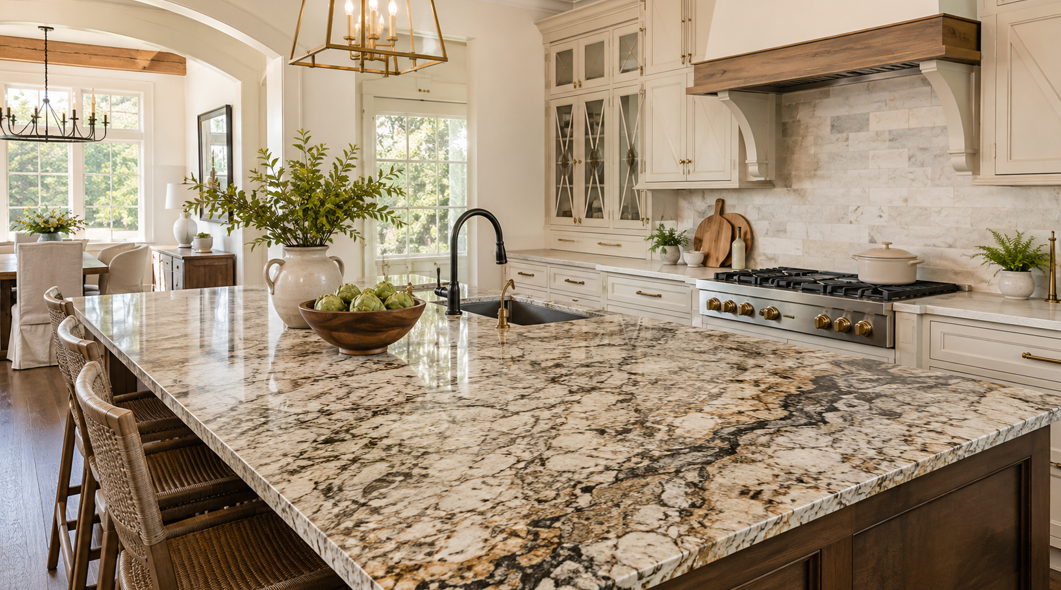
Choosing a kitchen countertop is a long-term design decision. The surface has to suit the room, support everyday cooking and cleaning, and remain attractive through years of family life. For Denham Springs homeowners, Louisiana heat, humidity and busy household routines add another layer to the decision.
Natural granite and engineered countertop materials can both create beautiful kitchens, but they offer different experiences. Granite is quarried from the earth, cut into slabs and finished to reveal colour, movement and mineral variation formed over time. Engineered options are manufactured from a controlled blend of materials, producing a more consistent pattern and appearance.
At Wholesale Flooring & Granite, customers can view natural stone in person and hand-select the exact slab that will be fabricated for their home. That direct warehouse experience matters because granite cannot be fully understood through a small sample or screen image. Every slab has its own character.
This comparison explains why many Denham Springs homeowners continue to prefer natural granite, where engineered materials may be a better fit, and how to choose a countertop based on appearance, maintenance, durability and value rather than trends alone.
Natural Granite Offers a Surface No One Else Has
The strongest visual advantage of natural granite is individuality. No two slabs are exactly alike. Mineral deposits, veining, speckles and shifts in tone create a surface that feels connected to the natural world rather than reproduced from a pattern.
That variation can be subtle or dramatic. Some slabs have a quiet, consistent background with fine mineral detail. Others feature sweeping movement, bold contrast or layered colours that become the main design feature in the kitchen. Homeowners can choose a stone that supports the cabinetry or select a statement slab that gives the room its identity.
This individuality is particularly valuable in custom renovations. A large kitchen island can showcase a broad section of movement, while perimeter counters may use calmer portions of the same slab. During fabrication planning, the team can consider where important veins, colour transitions or distinctive markings will appear.
Engineered surfaces offer a different benefit: predictability. Their patterns are designed to remain relatively consistent from sample to finished slab. That can be useful when a homeowner wants a highly uniform kitchen, needs several matching sections or prefers a controlled minimalist look.
The choice comes down to design priorities. A homeowner seeking perfect repetition may favour an engineered option. Someone who values organic variation, depth and a genuinely one-of-a-kind feature often finds natural granite more rewarding.
Granite also works across a broad range of interior styles. Dark stone with fine patterning can anchor white or pale cabinetry. Warm cream and brown granite can complement stained wood. Grey, black and white varieties can suit transitional or contemporary rooms, while richer gold, rust or green tones can create a more traditional Louisiana kitchen.
Because the material is natural, viewing full slabs is an important part of the process. A small sample may not reveal the overall movement, large mineral formations or changes across the surface. Hand-selecting a slab allows the homeowner to understand exactly what will become part of the finished room.
Granite Brings Proven Strength to Active Kitchens
Kitchen countertops experience daily wear from food preparation, small appliances, dishes, groceries and family routines. Natural granite is valued for its hard, durable surface and ability to perform well in active residential kitchens when it is properly fabricated, installed and maintained.
Granite resists everyday scratching better than many softer countertop materials. Cutting boards remain the better choice because they protect both the countertop finish and knife blades, but normal kitchen activity is unlikely to create the same wear seen on less durable surfaces.
The stone also handles ordinary kitchen heat well. A warm baking dish or pan is less likely to affect granite than materials containing resins, although trivets remain worth using. Sudden temperature changes, extreme concentrated heat and heavy impacts can damage almost any countertop, so practical protection extends the life of the surface.
Engineered materials are also durable, but their performance characteristics differ by composition and manufacturer. Many engineered options provide strong resistance to stains and daily wear. Surfaces containing resin can be more sensitive to high heat, which makes trivets especially important around cooktops, slow cookers and recently heated pans.
Granite is not indestructible. Edges around sinks, dishwashers and corners can chip if struck by a heavy object. Long unsupported overhangs may require additional support. Professional templating and fabrication help reduce these risks by matching edge profiles, seams and support details to the kitchen layout.
For families in Denham Springs, durability is often less about finding a completely maintenance-free surface and more about selecting a material that can be cared for realistically. Granite performs reliably when spills are wiped promptly, suitable cleaners are used and sealing is handled when needed.
Understanding Granite Maintenance in Louisiana Humidity
Louisiana’s humid subtropical climate affects the entire home, from flooring and cabinetry to paint and ventilation. Countertops are less vulnerable to indoor humidity than wood products, but kitchens still experience moisture from cooking, washing, condensation and seasonal conditions.
Granite is a natural stone and has some level of porosity. The amount varies by stone. Proper sealing helps limit the absorption of water, oils and strongly coloured liquids, making the surface easier to maintain. Sealing frequency depends on the specific granite, finish, household use and sealer selected. Some stones may need attention more often than denser varieties.
This maintenance is manageable rather than burdensome. Homeowners can ask the fabricator or installation team for guidance on the selected slab and suitable care products. A simple water test may also help indicate when the surface is absorbing moisture more readily, although professional advice remains valuable.
For daily cleaning, warm water, a soft cloth and a pH-neutral cleaner formulated for natural stone are reliable choices. Acidic products, harsh abrasives and aggressive scouring can dull the finish or affect the sealer. Spills from wine, cooking oil, coffee, juice and cosmetics are best wiped promptly.
Engineered countertop materials are often non-porous and generally do not require sealing. That lower-maintenance quality can be attractive in rental properties, secondary spaces or households that prefer a more uniform care routine.
However, “no sealing” does not mean “no care”. Engineered surfaces still benefit from prompt spill clean-up, non-abrasive tools and protection from concentrated heat. The right comparison is not maintenance versus no maintenance; it is which type of maintenance fits the household.
Good ventilation helps manage steam, heat and cooking residue, while prompt attention to plumbing leaks protects every kitchen finish. For many Denham Springs homeowners, occasional granite sealing is a reasonable trade-off for natural depth and variation. Others may prefer the predictable care of an engineered surface.
Granite and Engineered Options: A Fair Comparison
A useful comparison looks beyond a single feature. Appearance, heat response, maintenance, repair options, seams, cost and availability all influence the final decision.
Appearance
Natural granite provides genuine mineral variation. The surface may include colour shifts, small fissures, crystalline areas and movement that cannot be identically reproduced. These natural characteristics are part of the stone rather than manufacturing defects.
Engineered options provide greater pattern control. This can make it easier to achieve a clean, even appearance across multiple countertop sections. Some designs imitate marble or natural stone, while others use solid colours or fine textures that are not intended to look geological.
Heat and Daily Use
Granite generally offers strong heat resistance, although protective trivets remain sensible. Many engineered surfaces also perform well in everyday kitchens but may react less favourably to concentrated heat because of the binders used in production.
Both materials benefit from cutting boards, prompt cleaning and care around edges. A heavy impact can chip stone or damage an engineered surface, particularly at vulnerable corners and sink cut-outs.
Porosity and Staining
Properly sealed granite resists most common household stains, but neglecting spills or sealing can increase the risk of absorption. Engineered surfaces are typically non-porous, giving them an advantage for homeowners who want to avoid periodic sealing.
Repair and Refinishing
Small granite chips may be repairable by an experienced professional, although the result depends on the location, colour and extent of the damage. Engineered materials may also be repairable, but matching a manufactured pattern can be difficult in highly visible areas.
Seams
Large kitchens often require seams regardless of material. Their visibility depends on slab size, pattern, layout, fabrication and colour matching. Natural granite with movement may make seam planning more complex, while consistent engineered patterns can simplify alignment in some designs. A skilled fabricator can recommend practical seam locations that protect strength and appearance.
Value
Price varies widely within both categories. Granite includes entry-level, mid-range and premium selections, while engineered materials also span many price points. Slab rarity, thickness, finish, edge detail, cut-outs, layout and installation all affect the total.
Warehouse-direct selection can create exceptional value because homeowners can compare actual inventory and understand the available options before committing. Looking at the full project cost, rather than the material name alone, provides a more accurate comparison.
The Warehouse Showroom Advantage
Natural granite is best selected in person. Photographs can distort colour, hide texture and show only a small portion of the slab. Even professional images may not capture how reflective minerals, fine crystals or broad veins respond to the lighting in a room.
At the warehouse showroom, homeowners can walk around full granite countertops slabs, compare neighbouring pieces and identify the exact stone they want fabricated. This direct selection removes the uncertainty of approving a small sample and receiving a slab with unexpected movement later.
It also creates an opportunity to coordinate the stone with cabinet doors, flooring, tile and paint samples. A granite that appears cool grey by itself may reveal blue, green or warm undertones beside other materials. Viewing the complete palette together helps prevent clashes and supports a more cohesive kitchen.
Slab inspection can also reveal how the pattern will work across an island, sink run or corner. Homeowners can discuss which section might become the focal point, whether book-matching is possible, and how seams may interact with movement in the stone.
This hands-on experience is one of the main reasons natural granite remains appealing. The customer is not selecting a general colour family; they are choosing the exact surface that will become part of their home.
Wholesale pricing adds another advantage. Direct access to warehouse inventory can make high-quality stone more attainable and allows customers to compare value across several selections rather than assuming all granite carries the same cost.
How Natural Granite Supports Long-Term Home Design
A countertop often remains in place through several changes in paint, lighting, hardware and décor. Natural granite can adapt because it usually contains multiple tones rather than one perfectly flat colour.
A slab containing several neutral tones can remain compatible with future changes to paint, hardware or cabinetry. Dark granite can support traditional or contemporary rooms, while white and grey stones can work with brass, nickel or black finishes.
Granite may also appeal to future buyers who recognise it as a durable, premium material, although any effect on resale depends on the wider renovation and local market. It is better selected for daily enjoyment than for a promised return.
Bold movement can create a statement island, while calmer patterns often suit extensive perimeter counters. The right choice depends on the homeowner’s style and the role the surface will play in the room.
When an Engineered Surface May Be the Better Choice
Natural granite is not the automatic answer for every project. Honest guidance includes recognising where engineered materials have practical advantages.
A homeowner who wants a highly uniform pattern may prefer an engineered surface. It can also simplify coordination in a large kitchen where several sections need to match closely. Certain contemporary designs rely on consistent white, pale grey or solid-colour surfaces that are easier to achieve through manufacturing.
The absence of routine sealing may appeal to households seeking the lowest possible maintenance. Engineered options can also be useful in applications where predictable sample-to-slab consistency is a priority.
Availability and project timing may influence the choice as well. A specific natural stone can vary from shipment to shipment, while manufactured collections are often designed for repeatable ordering. However, availability still depends on stock, production and distribution.
The goal is not to declare one category superior in every situation. It is to match the material to the household. Homeowners who value natural variation, heat tolerance and direct slab selection often prefer granite. Those prioritising pattern consistency and non-porous maintenance may lean towards engineered options.
Questions to Ask Before Choosing a Countertop
Before making a final selection, consider how the kitchen functions and which qualities matter most.
How much variation feels comfortable? Some homeowners love the character of mineral movement, while others prefer visual consistency.
How is the kitchen used? Frequent cooking, large family meals and entertaining may place more emphasis on heat performance, edge durability and easy cleaning.
What level of maintenance fits the household? Occasional sealing may be acceptable in exchange for natural stone, or a non-porous surface may feel more practical.
Which finish suits the design? Polished granite reflects light and enhances colour, while honed or leathered finishes create a softer, more textured effect. Finish options vary by stone.
How will the slab be laid out? Islands, corners, sinks, cooktops and seams all affect where movement appears.
What is included in the estimate? Material, templating, fabrication, edge profiles, cut-outs, supports, removal and installation may be priced differently. A clear written estimate makes comparisons more useful.
Why Many Denham Springs Homeowners Still Choose Granite
Natural granite continues to earn its place in Louisiana kitchens because it offers qualities that engineered materials cannot fully reproduce. Each slab is unique, the surface is durable, and the homeowner can take part in selecting the exact stone used in the finished project.
Its maintenance requirements are real but manageable. Proper sealing, gentle cleaning and prompt attention to spills help granite perform well in Baton Rouge-area humidity and active family kitchens. In return, homeowners receive a surface with natural depth, individual character and strong long-term appeal.
Engineered options remain excellent choices for uniform designs and low-maintenance priorities. A fair comparison recognises those benefits while also acknowledging the value of authentic stone, warehouse selection and direct access to actual slabs.
Wholesale Flooring & Granite gives Denham Springs homeowners the opportunity to compare materials in person, hand-select natural granite and coordinate countertops with flooring, tile and cabinetry under one roof. The knowledgeable team can explain the practical differences clearly.
To compare available slabs, discuss fabrication or request a free estimate, contact us and plan a visit to the Baton Rouge warehouse showroom.


